
Online Quran Qirat Classes: Learn the 7 & 10 Qirat with Al-Azhar Teachers
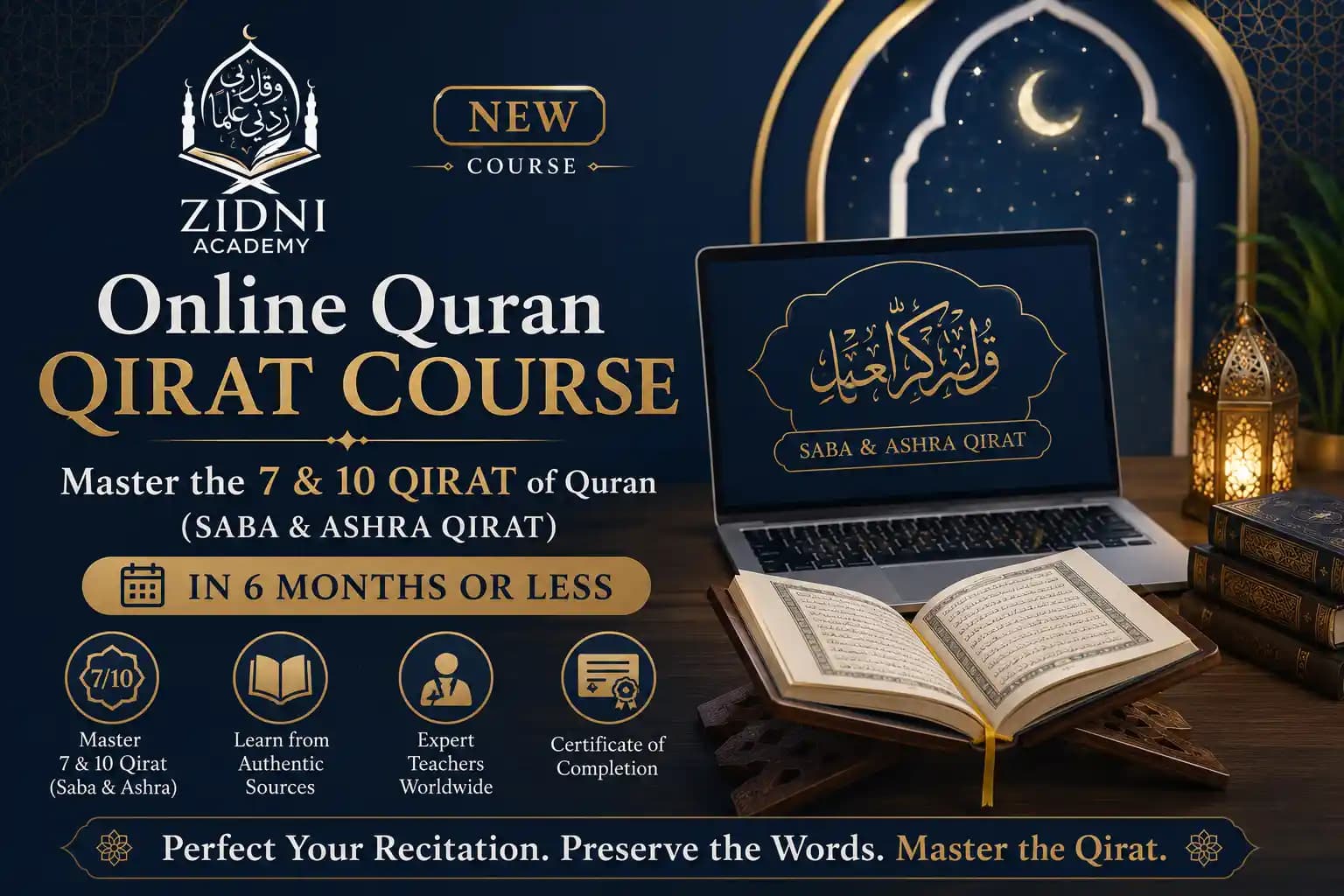
Online Quran Qirat Classes: Learn the 7 & 10 Qirat with Al-Azhar Teachers
Online Quran Qirat classes at Zidni Academy take you beyond standard Tajweed into the science of the Ten Readings, with certified Al-Azhar teachers in live 1-on-1 lessons. Study from the UK, USA, Canada, Australia or the Gulf at times that suit your time zone, and follow a clear path toward a Qirat Ijazah. Every student starts with a free trial and a recitation assessment, so you begin at the right level.
Qirat Course Online | Online Qirat Course for UK, USA, Canada and Australia
For serious students of the Quran in English-speaking countries, finding a qualified teacher in the science of Qirat has historically required traveling to Egypt, Saudi Arabia, or other Muslim-majority countries where this level of scholarship exists in accessible form.
Zidni Academy removes that barrier entirely.
Our Online Quran Qirat classes connect students in the UK, USA, Canada, Australia, UAE, Saudi Arabia, Qatar, and across the Gulf with certified Al-Azhar teachers who hold formal qualifications in the Ten Readings — teachers who have themselves received Ijazah in Qirat through a connected Sanad back to the Prophet Muhammad ﷺ.
This is not an introductory Tajweed course marketed as Qirat instruction. This is the real science — taught by scholars who carry it authentically.
About Zidni Academy — Our Qirat Teachers
The quality of a Qirat course is entirely determined by the credentials of the teacher. At Zidni Academy, our Qirat specialists are experienced, Al-Azhar-trained Qirat teachers:
Teacher Hossam Othman — 7+ years of experience, certified in the Ten Readings (Al-Qira'at Al-Ashr) with a connected Sanad. Has personally certified more than 20 students in Quranic recitation. Combines deep mastery of the recitation traditions with the ability to teach them clearly to students at all levels.
Teacher Mohamed Yaseen — 9+ years of experience, Al-Azhar graduate, Imam and preacher, certified in the Ten Readings and holds a TOT (Training of Trainers) certificate in memorization. Specializes in helping students build the fluency and precision required for formal Qirat certification.
Both teachers hold their certifications through a documented chain of transmission — meaning the Qirat knowledge they teach is traceable, authenticated, and part of the living tradition of Quranic scholarship that has preserved these recitations since the time of the Prophet ﷺ.
Global Qirat Course Learning — UK | USA | Canada | Australia
Our Online Quran Qirat classes is designed specifically for the realities of Muslim life in Western countries:
Time zone coverage: Sessions run in your local time: GMT/BST in the UK; Eastern, Central, Mountain and Pacific time in the USA and Canada; and AEST/AEDT in Australia. Some regions do not change their clocks, so confirm your slot whenever clocks change.
Schedule flexibility — Professional Muslims in Western countries have demanding careers and family commitments. Our sessions happen when you're available — morning before work, evening after family time, or weekends.
English-medium instruction — Our Qirat teachers explain the science of Qirat, its historical transmission, and the differences between the readings clearly in English — so nothing is ever lost in translation.
No local mosque dependency — In many Western cities, Qirat teachers at the level required for formal instruction simply don't exist locally. Our online platform removes this limitation permanently.
Online Quran Qirat Classes — What Is Qirat?
Before enrolling in any Qirat course, it's essential to understand what Qirat actually is.
Qirat (القراءات)
refers to the different authentic methods of reciting the Quran — each transmitted through a distinct chain of narrators back to the Prophet Muhammad ﷺ. These are not different versions of the Quran. They are different authenticated ways of reciting the same Quran — each reflecting the multiple ways in which the Quran was revealed and transmitted.
The Seven Qirat (Saba' Qirat)
These are the seven primary methods accepted by the overwhelming consensus of Islamic scholarship: Nafi', Ibn Kathir, Abu 'Amr, Ibn 'Amir, 'Asim, Hamza, and Al-Kisa'i.
The Ten Qirat (Ashra Qirat)
Three additional recitations are added to the seven: Abu Ja'far, Ya'qub, and Khalaf — bringing the total to ten accepted methods.
Why does this matter?
Hafs 'an 'Asim — the recitation most Muslims worldwide use in daily prayer — is one narration within one of the Seven Qirat. Learning the full spectrum of Qirat means understanding the breadth and miracle of Quranic transmission, and joining the chain of scholars who have preserved this knowledge for over 1,400 years.
Qira’a, Riwaya and Tariq: What Is the Difference?
Qirat (also written Qiraat, Qira’at, Qiraah or Kirat) refers to authentic methods of reciting the same Quran. Three terms help you understand how they are organised:
Term | Meaning | Example |
|---|---|---|
Qira’a | A recognised method of recitation, named after an Imam | The Qira’a of Imam ‘Asim |
Riwaya | A narration of that Qira’a through one of the Imam’s students | Hafs ‘an ‘Asim, Shu’ba ‘an ‘Asim |
Tariq | A further path of transmission from a narrator to later scholars | Paths organised in texts such as ash-Shatibiyya (seven) and Tayyibat an-Nashr (ten) |
Your teacher explains which texts and riwayat your own path follows. In North and West Africa, many Muslims recite Warsh ‘an Nafi’, so Qirat study is also practical for families with Maghrebi or West African roots, for imams, and for students who want an Ijazah in a specific riwaya.
What Students Will Learn in Our Online 10 Quran Qirat Classes
Our Online Quran Qirat classes is structured as a complete, progressive education in the science of Quranic recitation. Here is exactly what you'll master:
Understanding Qirat and Its Importance
You begin with the foundation: the history, theology, and scientific basis of the Qirat tradition. Why do multiple authentic recitations exist? What is the difference between a Qira'a, a riwaya, and a tariq? How were these methods transmitted, and what documentation validates their authenticity?
This foundational knowledge is not optional — it is the context that makes everything else meaningful. A student who understands why Qirat exist learns them with entirely different depth than one who simply learns them mechanically.
Mastering Hafs 'an 'Asim Recitation
Before progressing to the full spectrum of Qirat, every student's recitation of Hafs 'an 'Asim — the most widely used recitation worldwide — must be brought to the standard of full Tajweed mastery.
Your teacher conducts a thorough recitation assessment in the first session. Any remaining Tajweed gaps — subtle errors in Madd lengths, Qalqalah, Tafkheem and Tarqeeq, or Waqf — are identified and corrected systematically before the Qirat curriculum advances.
This is not a shortcut. It is the correct sequence. No authentic Qirat teacher advances a student to multiple readings before their foundational recitation is solid.
Applying Tajweed Rules Across Multiple Qirat
Each of the Ten Qirat has its own specific rules — differences in Madd lengths, vowel qualities, assimilation patterns, and stopping positions. As you advance through the Qirat, your teacher guides you through the specific Tajweed variations that characterize each reading:
The elongation differences between Hafs and Warsh. The unique Madd Munfasil rules of Qalun. The characteristic features of the Shu'ba narration. The specific stopping and assimilation rules of Hamza's recitation. Each reading has a distinctive profile — and mastering it requires both knowledge of the rules and extensive supervised practice.
Developing Proper Pronunciation and Articulation
The differences between Qirat are not just theoretical — they are phonetic. Some readings elongate certain vowels. Others have specific assimilation rules. Some maintain sounds that are merged in other readings.
Your teacher demonstrates every phonetic distinction, ensures you can produce it correctly, and tracks your consistency across sessions. This is the precision work that separates a student who knows the Qirat intellectually from one who can recite them authentically.
Engaging in Interactive Recitation Practice
Every session includes live recitation practice. You recite extended Quranic passages using the specific Qira'a under study — your teacher listens, corrects in real time, and provides targeted feedback.
This interactive, live-correction model is irreplaceable in Qirat education. The differences between readings are subtle — and they must be heard and corrected by a trained ear, not self-assessed from a textbook.
Choose Your Qirat Pathway
Adults, Huffaz and Imams
If you read with confident Tajweed or have memorised the Quran, you can begin Qirat after a recitation assessment. Choose a single riwaya or progress toward the full Ten. Imams, teachers and Huffaz often study Qirat to strengthen accuracy and teach with authority. See our online Quran classes for adults (advanced).
Sisters
Sisters can study Qirat in private sessions and may request a female teacher. Availability of female Qirat teachers is confirmed when you book your free trial. See our Quran classes for sisters (advanced).
Children and Teens
Qirat is not a starting point for young children. A child should first read fluently with Tajweed and, ideally, have memorised a good portion of the Quran. Mature teens who meet this standard can begin a gentle introduction after a teacher’s assessment. Younger children build the foundation first with our advanced Quran classes for kids.
Are You Ready for Qirat?
You are ready to begin if you can:
- Recite the Quran fluently in Hafs ‘an ‘Asim.
- Apply the main Tajweed rules (Madd, Ghunna, Qalqalah, Tafkheem and Tarqeeq, Waqf) with consistent accuracy.
- Recite long passages without frequent stops.
Memorisation helps but is not always required. If you are not there yet, start with Tajweed or memorisation first (see the courses mentioned below). Not sure? Your free trial includes a recitation assessment.
Our Curriculum for the Online Qirat Course
Our curriculum follows the authentic sequence used by Al-Azhar scholars to teach the Qirat tradition:
Stage 1 — Tajweed Mastery Review
Full assessment and correction of Hafs 'an 'Asim recitation. No gaps allowed before advancing.
Stage 2 — Introduction to Qirat and Tajweed Science
History, transmission, and methodology of the Qirat tradition. Understanding the Sanad system and the categories of variation between readings.
Stage 3 — Arabic Phonetics Deep Dive
The phonetic distinctions specific to Qirat — articulation points, vowel qualities, and assimilation patterns that vary across the readings.
Stage 4 — Hafs 'an 'Asim to Mastery Standard
Confirming and solidifying Hafs recitation to the level required before introducing additional readings.
Stage 5 — The Seven Qirat (Saba' Qirat)
Progressive study of each of the seven accepted recitations — with full Tajweed rules, phonetic distinctions, and supervised recitation practice for each.
Stage 6 — The Ten Qirat (Ashra Qirat)
Adding the three additional recitations (Abu Ja'far, Ya'qub, Khalaf) to complete the Ten Readings — with the same structured approach applied to each.
Stage 7 — Interactive Recitation Sessions
Full Quran recitation review sessions — testing fluency and accuracy across multiple Qirat with your teacher.
Stage 8 — Preparing for Ijazah Certification
Structured preparation for formal Ijazah assessment — systematic Quran review, Sanad documentation, and final examination with your certified teacher.
How Long Does It Take to Learn Qirat?
It depends on your starting level, how many riwayat you choose, and how often you practise. A student who already recites Hafs accurately can begin Qirat at once. Preparing for an Ijazah in the Ten Readings is a long-term journey measured in years, not weeks. After your assessment, your teacher gives you a realistic plan for the path you choose.
Learning Levels of Our Online Qirat Lessons
Beginner Level
For students who are new to Qirat. They learn the basics of Arabic phonetics, how to pronounce the letters correctly, and the foundational Tajweed rules needed to begin reciting the Quran with the standard Hafs recitation — building the platform from which Qirat study launches.
Intermediate Level
For students who know Tajweed but need more practice and refinement before entering Qirat study. They refine their recitation, apply advanced Tajweed rules with consistency, and correct remaining errors with guidance from certified tutors through regular supervised practice.
Advanced Level
For students who want to master Qirat for Ijazah certification. They focus on perfecting their recitation across multiple Qirat styles, learning the specific rules and phonetic distinctions of each reading, and practicing for the formal assessment that confirms their certification readiness.
Why Choose Zidni Academy for Your Online Quran Qirat classes?
Ten Readings Certified Teachers
Teacher Hossam Othman and Teacher Mohamed Yaseen hold certifications in the Ten Readings with connected Sanads. These credentials take years to earn, and you are welcome to ask about them — and they are what your Qirat course requires.
Connected Sanad — Authentic Transmission
The Sanad is not a formality. It is the chain of transmission that connects your recitation to the Prophet ﷺ through every teacher in between. At Zidni Academy, both our Qirat teachers carry authenticated Sanads — which means the Ijazah you pursue through them carries the same authenticity.
Fully Private 1-on-1 Sessions
Qirat study requires individual attention. The differences between readings are subtle, and a teacher who is working with multiple students simultaneously cannot provide the level of correction that Qirat mastery demands.
Structured Progression — No Shortcuts
Our curriculum does not skip stages or compress timelines in ways that undermine learning. The sequence is authentic, the progression is thorough, and no student advances until their current level is genuinely solid.
Ijazah Pathway
Completing our advanced Qirat program leads directly to Ijazah eligibility — a formal certification in one or more of the Qirat, with a documented Sanad, assessed and granted by your certified teacher.
Quran Qirat Course Pricing
Plan | Price | Best For |
|---|---|---|
Confident Start | $8 / hour | Flexible Qirat sessions |
Knowledge Expert | $7.5 / hour | More than 10 sessions per month |
Family Excellence | $7 / hour | Prepaying 3 months or 3 siblings |
Every plan starts with a free trial session. You pay for a package only after the trial. See the pricing page for current details.
✅ Free trial session — no upfront payment, no commitment
✅ Ten Readings certified teachers with connected Sanad
✅ Fully private 1-on-1 sessions
✅ Monthly progress reports
✅ Ijazah pathway upon advanced level completion
✅ Official completion certificate at end of every stage
Common Challenges Students Face When Learning Qirat
Learning Quran Qirat can seem challenging at first, especially for students encountering multiple authentic recitation methods for the first time. Common difficulties include distinguishing between the accepted Qira’at, maintaining accurate pronunciation across different narrations, understanding where recitation variations occur, and preserving fluency without confusion. At Zidni Academy, students overcome these challenges through personalized one-on-one instruction, gradual progression from foundational concepts to advanced application, continuous correction by certified Al-Azhar teachers, and structured practice using authentic chains of transmission. This step-by-step approach builds confidence while helping students master each Qira’ah with accuracy and clarity.
Who Should Study Quran Qirat?
Quran Qirat is not only for scholars or advanced students pursuing Ijazah. It is ideal for anyone who has already built a strong foundation in Tajweed and wants to deepen their understanding of the authentic methods of Quran recitation. Many Huffaz study Qirat to strengthen their memorization, while advanced Quran students learn it to appreciate the richness and precision of Quranic transmission. Others pursue Qirat as part of their journey toward Ijazah and connected Sanad. Before beginning Qirat, however, students should first master the rules of Tajweed and establish accurate recitation, which is why many learners start with our Learn Quran With Tajweed Online course before advancing to the science of Qirat.
Strengthen Your Quran Memorization
Although memorizing the entire Quran is not always required to begin studying Qirat, having a strong memorization foundation makes it easier to compare narrations and apply different recitation methods confidently. Many students choose to improve their memorization first before advancing to Qira’at through our Quran Memorization Course, where they receive structured guidance from certified Al-Azhar teachers.
Why Learn Qirat with a Certified Teacher?
The science of Qira’at has been preserved through authentic chains of transmission for centuries, making qualified instruction essential. Learning with a certified teacher ensures that every pronunciation, recitation variation, and application follows authentic scholarly tradition. Students receive immediate correction, personalized guidance, and continuous feedback, helping them avoid common mistakes while developing confidence in every Qira’ah. This structured approach not only improves accuracy but also preserves the authenticity of the Quran exactly as it has been transmitted from generation to generation.
Frequently Asked Questions
Do I need to know Tajweed before studying Qirat?
Yes. You should recite Hafs ‘an ‘Asim accurately first. Your free trial includes an assessment to confirm your level.Can I study only one Qira’a or riwaya?
Yes. You can focus on a single riwaya or progress toward the Ten, depending on your goal and teacher availability.How long does it take to learn Qirat?
It depends on your level, your chosen riwayat and your practice. The Ten Readings are a multi-year path. Your teacher gives a realistic plan after assessment.Can sisters study Qirat with a female teacher?
Yes. You can request a female teacher, and availability is confirmed when you book your free trial.Can children learn Qirat?
Children should first read fluently with Tajweed. Mature teens who meet this standard may begin an introduction after assessment.Is there a free online Qirat course?
There is no free full Qirat course that leads to an Ijazah. Qirat is learned by reciting to a teacher who corrects you live. Zidni Academy offers a free trial lesson, and free resources can introduce terms but cannot replace live correction.How much do online Qirat classes cost?
Zidni Academy lists $7 to $8 per hour depending on the plan. Every plan starts with a free trial, and you pay only after the trial.Will I receive an Ijazah?
Advanced students may be eligible. The Ijazah is granted by the certified teacher after assessment, and no timeline is guaranteed.Can I really learn Qirat online?
Yes, when lessons are live and one-to-one, because Qirat is learned by listening and reciting to a teacher. Ask about the teacher’s Sanad before you begin.
Start Your Qirat Journey with a Free Trial
Book a free trial lesson. Your teacher assesses your recitation, confirms your level and agrees a realistic plan. Whether you are an adult learner, a sister, or a parent of a teen who reads with Tajweed, the first step is the same. Book your free trial lesson.