
Learn Quran With Tajweed Online – Intermediate Course for Confident Recitation
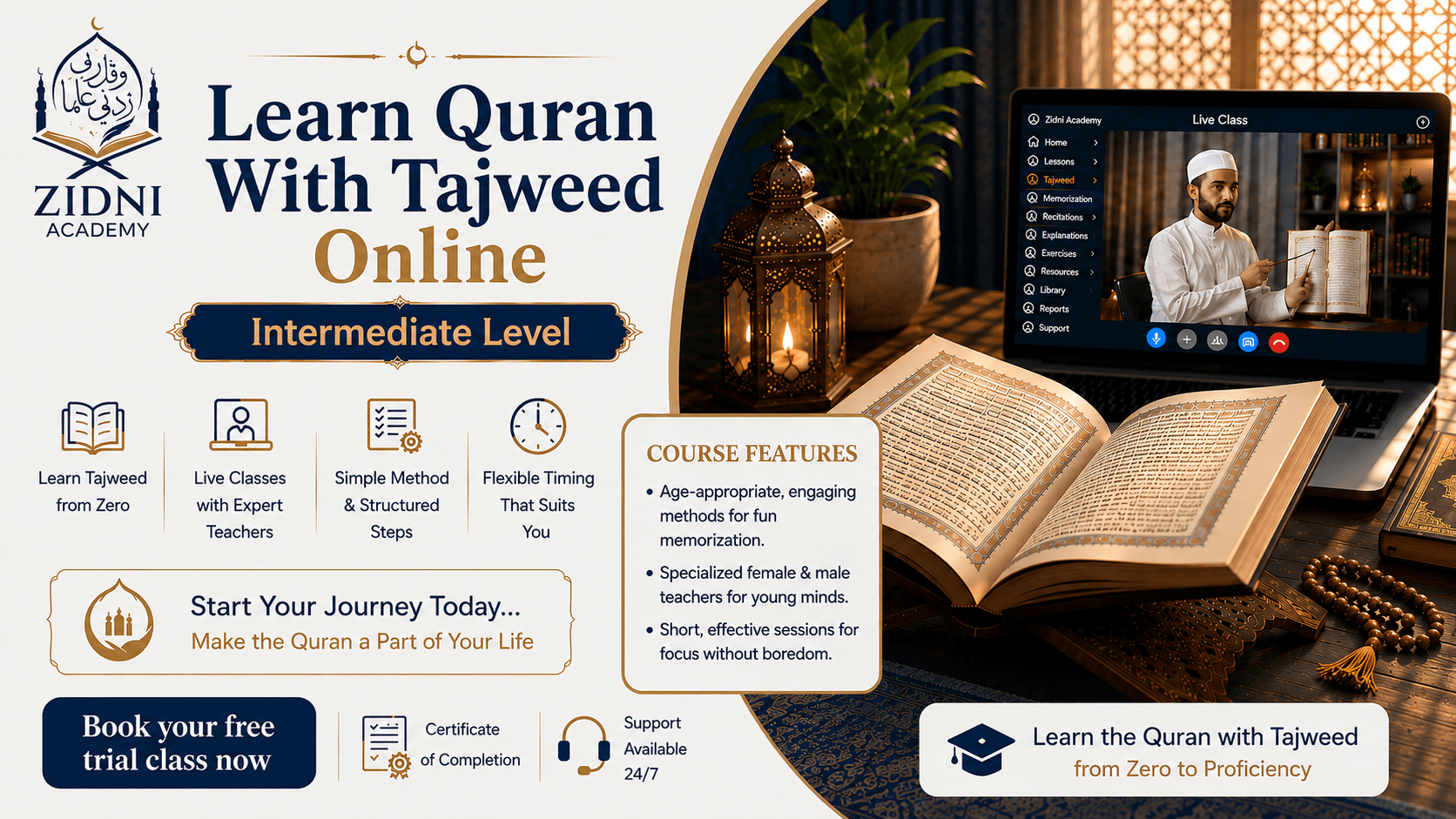
Learn Quran With Tajweed Online – Intermediate Course for Confident Recitation
You've already learned the basics of Quran reading and Tajweed. Now it's time to make those rules part of your natural recitation. Zidni Academy's intermediate Quran Tajweed course is designed for students who can already read Arabic with Harakat and understand basic Tajweed, but still experience hesitation, pronunciation inconsistencies, or difficulty applying several rules at once. Through live 1-on-1 lessons with qualified Al-Azhar teachers, you'll strengthen your recitation, master more advanced Tajweed rules, improve your fluency, and learn to identify and correct subtle mistakes. Whether you're an adult, student, parent, or sister living in the United States, your lessons are scheduled around your routine. Book a free trial and let your teacher assess your current recitation level before you begin.
What You'll Learn in This Intermediate Tajweed Course
This intermediate course builds directly on your existing foundation and takes your recitation to a level of genuine confidence and beauty:
Module 1 — Advanced Madd Rules
Full mastery of all Madd categories with their conditions, lengths, and Quranic examples. You'll never hesitate on a Madd again.
Module 2 — Qalqalah Mastery
Understanding the echo effect of the five Qalqalah letters in Sukun and Waqf positions — applied directly in recitation.
Module 3 — Ghunna & Its Degrees
Identifying and producing the correct nasal sound across all relevant rule contexts — Ikhfaa, Idghaam with Ghunna, and more.
Module 4 — Tafkheem & Tarqeeq
The rules for heavy and light letters — with special focus on Raa (ر) in all its contexts and the Grand Lam in Allah's name.
Module 5 — Fluent Recitation Practice
Applying all rules simultaneously in reciting from Al-Baqarah, Al-Imran, and other longer Surahs — building natural, flowing Tajweed.

Who Is This Intermediate Quran Tajweed Course For?
This course is not designed for complete beginners.
It is the right level if you can already:
- Recognize and pronounce Arabic letters
- Read Quranic words with Harakat
- Read short Surahs independently
- Understand basic Tajweed concepts
- Apply basic Noon Sakinah and Tanween rules
- Recognize basic Meem Sakinah rules
But you may still struggle with:
- Maintaining Tajweed while reading longer passages
- Applying several rules simultaneously
- Correct Madd lengths
- Qalqalah
- Ghunna
- Tafkheem and Tarqeeq
- Raa rules
- Waqf and Ibtida
- Fluency and natural recitation
- Identifying your own subtle mistakes
If that sounds like your current level, the intermediate stage is where your Quran reading can move from basic correctness to confident practical recitation.
If you cannot yet read Arabic comfortably, you should begin with the Beginner Tajweed Course rather than starting at the intermediate level.
What Does Intermediate Tajweed Mean?
The intermediate Tajweed level is the bridge between knowing Tajweed rules and applying them naturally while reciting the Quran.
At the beginner stage, you may learn what a rule means.
At the intermediate stage, you need to recognize the rule while reading, apply it correctly, maintain your pronunciation, and continue reciting without losing your fluency.
That means your teacher focuses not only on whether you know the rule, but also on:
- How you pronounce it
- When you apply it
- How long you apply it
- How it changes in different contexts
- Whether you can maintain it throughout a longer passage
The goal is to make correct Tajweed increasingly automatic.
Why Learn Quran With Tajweed at the Intermediate Level?
The intermediate stage is where many students notice the biggest difference in their recitation.
You may already know the terminology but still find yourself stopping mentally before applying a rule.
You may also read correctly in short examples but lose accuracy when reciting a longer Surah.
Intermediate Quran with Tajweed training addresses this gap through repeated practical application.
You Develop Better Fluency
Instead of concentrating on one rule at a time, you learn to maintain multiple Tajweed rules while continuing your recitation.
You Improve Accuracy
Your teacher identifies recurring pronunciation problems and works with you to correct them.
You Control Your Recitation Better
You begin working with different recitation speeds and pacing while maintaining Tajweed.
You Handle Longer Surahs
Practice gradually moves beyond short beginner passages into longer sections of the Quran.
You Become More Independent
The ultimate goal is not to depend on your teacher forever.
You should increasingly be able to recognize and correct common mistakes in your own recitation.

What Will You Learn in This Intermediate Quran Tajweed Course?
The curriculum builds on your existing knowledge rather than repeating the entire beginner level.
Module 1 — Advanced Madd Rules
You'll move beyond basic natural Madd and study different types of elongation in greater depth.
Topics can include:
- Madd Munfasil
- Madd Muttasil
- Madd Lazim
- Madd Arid Lissukun
- Conditions for each type
- Appropriate lengths
- Quranic examples
- Practical application during recitation
The objective is to stop treating Madd as something you calculate mentally every time you read.
With practice, the correct application should become increasingly natural.
Module 2 — Qalqalah
You'll study the five Qalqalah letters:
ق ط ب ج د
The focus is not simply memorizing the letters.
You'll learn how Qalqalah changes depending on where the letter occurs and how it is affected by Sukun and Waqf.
Your teacher demonstrates the sound, listens to your pronunciation, and helps you develop a controlled Qalqalah without exaggerating the echo.
Module 3 — Ghunna and Its Degrees
Ghunna is another area where students often understand the rule theoretically but struggle to maintain the correct sound during continuous recitation.
You'll practice Ghunna in relevant contexts, including:
- Ikhfa
- Idgham with Ghunna
- Meem-related rules
- Different levels of nasal sound
- Practical Quranic examples
Your teacher focuses on hearing and producing the correct sound rather than memorizing terminology alone.
Module 4 — Tafkheem and Tarqeeq
You'll develop greater control over heavy and light pronunciation.
This includes focused practice with:
- Heavy letters
- Light letters
- Raa (ر)
- Lam in the name of Allah
- Context-dependent pronunciation
These rules can be difficult to master without listening to an experienced teacher.
The teacher can demonstrate the correct sound and then immediately identify where your pronunciation needs adjustment.
Module 5 — Waqf and Ibtida
Correct stopping is an essential part of fluent Quran recitation.
At the intermediate level, you'll study stopping in greater detail, including:
- Waqf Tam
- Waqf Kafi
- Waqf Hasan
- Waqf Qabih
- Appropriate stopping points
- Resuming the recitation correctly
The objective is to understand how stopping affects both recitation and meaning.
Module 6 — Lahn and Recitation Errors
Intermediate students need to become more aware of the difference between obvious and subtle recitation mistakes.
You'll learn to recognize:
- Lahn Jali — obvious errors
- Lahn Khafi — subtle errors
Your teacher identifies the errors that appear repeatedly in your own recitation and creates practice around them.
This makes the course personalized rather than simply following a generic checklist.
Module 7 — Fluent Quran Recitation
Rules only become useful when you can apply them while reading continuously.
You'll practice longer Quranic passages from Surahs such as Al-Baqarah, Al-Imran, and other suitable portions according to your level.
Your teacher listens for:
- Fluency
- Pronunciation
- Madd
- Ghunna
- Qalqalah
- Tafkheem
- Tarqeeq
- Waqf
- Overall consistency
The objective is confident Quran recitation with Tajweed, not simply completing a list of rules.
Quran and Tajweed: From Rules to Real Recitation
One of the biggest differences between beginner and intermediate learning is the relationship between theory and practice.
A beginner may ask:
"What is this rule?"
An intermediate student should increasingly ask:
"Did I apply this rule correctly while reciting?"
That is why intermediate lessons use a continuous cycle:
Learn → Listen → Recite → Correct → Repeat → Apply in Longer Passages
This cycle helps turn theoretical Tajweed knowledge into practical Quran recitation.
How Do Online Tajweed Classes Work at the Intermediate Level?
Zidni's tajweed classes online are delivered through private live instruction.
Your teacher does not simply present a lesson and move on.
Instead, the session can include:
- A short explanation of the rule
- Teacher demonstration
- Quranic examples
- Your own recitation
- Immediate correction
- Repetition
- Longer practical application
This is especially important at the intermediate level because many mistakes become noticeable only when several rules appear together in real Quranic passages.
Practical Quran Tajweed Online Training
Intermediate quran tajweed online learning should be practical as well as theoretical.
During a lesson, your teacher may stop you at the exact moment a mistake occurs.
For example, if you incorrectly apply Madd, the teacher can:
Identify → Explain → Demonstrate → Ask You to Repeat → Recheck
The same approach can be used for:
- Raa pronunciation
- Qalqalah
- Ghunna
- Heavy and light letters
- Waqf
- Other recurring Tajweed errors
This immediate feedback is one of the main advantages of live 1-on-1 instruction.
What Makes Zidni Academy's Intermediate Tajweed Classes Different?
Qualified Al-Azhar Quran Teachers
Zidni Academy's Quran learning programs are taught through qualified teachers with Al-Azhar backgrounds and experience in Quran and Tajweed instruction.
At the intermediate level, the focus becomes more specialized: the teacher needs to recognize subtle recitation errors and explain exactly how to correct them.
Private 1-on-1 Lessons
Your recitation receives the teacher's full attention.
There is no need to wait for other students to finish their turn before receiving correction.
Personalized Learning
Two intermediate students may have completely different weaknesses.
One may struggle with Raa.
Another may have inconsistent Madd.
Another may read fluently but have problems with Waqf.
Your lessons can therefore focus on your actual recitation rather than assuming every student needs exactly the same amount of practice.
Flexible Scheduling
Students in the United States can arrange lessons around work, school, family responsibilities, and other commitments.
Morning, afternoon, evening, or weekend availability can be considered when building the schedule.
Female Quran Teachers
Sisters who prefer to learn with a female Quran teacher can request an appropriate female instructor, subject to availability.
Female instruction can be particularly useful for students who want a comfortable private environment for detailed recitation correction.
Learn Tajweed Anytime From Your Phone, Tablet, or Laptop
You don't need to commute to a Quran center to continue your intermediate Tajweed journey.
Your online lesson can take place from a suitable private location using a compatible device and internet connection.
For busy students in the USA, this makes it easier to maintain consistent Quran study without adding travel time to an already full schedule.
The goal is simple:
Make consistent Quran learning easier to maintain.
How Your Intermediate Tajweed Lesson Progresses
A typical lesson can follow a structured sequence.
Step 1 — Review
You revisit the previous rule or recitation assignment.
Step 2 — New Concept
Your teacher introduces the next Tajweed concept using Quranic examples.
Step 3 — Demonstration
You listen to the correct pronunciation before attempting the example yourself.
Step 4 — Guided Recitation
You recite while your teacher listens carefully.
Step 5 — Error Correction
Mistakes are identified and corrected immediately.
Step 6 — Extended Reading
You apply the rule in a longer Quranic passage.
Step 7 — Practice Assignment
You receive material to practice before the next session.
This structure helps connect every lesson to actual Quran recitation.
Intermediate Tajweed Course Structure
Feature | Details |
|---|---|
Format | Private 1-on-1 live sessions |
Session Length | 30 or 60 minutes |
Schedule | Flexible days and times |
Learning Method | Theory + live Quran recitation |
Correction | Real-time teacher feedback |
Study Materials | Supplementary Tajweed materials and Quranic examples |
Progress Tracking | Regular performance review |
Certificate | Certificate upon level completion |
Trial | Free trial before regular enrollment |
The intermediate course is designed around progression rather than simply counting completed lessons.
How Long Does the Intermediate Tajweed Level Take?
There is no identical timeline for every student.
A learner who already reads fluently and needs correction in a few specific areas may progress faster than someone who understands Tajweed but has developed several pronunciation habits over many years.
Progress depends on:
- Current recitation level
- Number of weekly sessions
- Practice between lessons
- Pronunciation difficulties
- Ability to apply rules in longer passages
- Consistency
Your initial assessment gives the teacher a better understanding of where you are and what needs the most attention.
How to Practice Quran With Tajweed Between Classes
Your progress should continue outside the live lesson.
A simple practice routine can include:
Read the Same Passage Again
Repeat the passage your teacher corrected during the lesson.
Focus on One Weakness
If your main problem is Raa, focus specifically on Raa instead of trying to fix every Tajweed issue simultaneously.
Record Your Recitation
Listening to yourself can reveal inconsistencies you may not notice while reading.
Practice Longer Passages
Once the rule is comfortable in a short example, apply it to a longer passage.
Review Previous Corrections
Do not allow an old mistake to return simply because you moved on to a new rule.
You can also reinforce Tajweed concepts through Zidni's Tajweed Rules Tests as an additional way to review rules between lessons.
Quran With Tajweed for Adults in the USA
Adults often reach the intermediate level with very different backgrounds.
Some learned Quran as children but stopped practicing.
Some can read Arabic fluently but never studied Tajweed systematically.
Others completed a beginner Tajweed course and now want more detailed correction.
For these learners, the objective is not to start over.
The teacher should first identify what you already know and then concentrate on the gaps affecting your recitation.
That makes intermediate Quran with Tajweed study more efficient and relevant to your actual needs.
Intermediate Quran Tajweed for Sisters
Many sisters prefer a female Quran teacher for private recitation lessons.
At the intermediate level, this can be especially valuable because lessons involve detailed pronunciation correction and extended recitation practice.
A female teacher can work with you on:
- Advanced Tajweed rules
- Quran recitation
- Pronunciation
- Fluency
- Waqf
- Hifz-related recitation
- Personal weaknesses
If your Quran goals also include broader Islamic education, Zidni's Islamic courses for women provide a wider learning pathway alongside Quran and Tajweed.
Intermediate Tajweed and Quran Memorization
If you are planning to memorize more Quran, improving Tajweed at the intermediate level can strengthen the quality of your Hifz.
A practical progression is:
Accurate Reading → Tajweed → Fluent Recitation → Memorization → Continuous Revision
Students who are ready to combine strong recitation with systematic memorization can continue into Zidni's Quran Memorization Course after establishing the necessary reading and Tajweed foundation.
The goal is not simply to memorize more verses.
The goal is to memorize and recite them accurately.
When Are You Ready for Advanced Tajweed?
You may be ready for the advanced level when:
- Your basic Tajweed is consistent
- You can recite longer passages comfortably
- You recognize most common Tajweed rules while reading
- Your pronunciation is generally accurate
- You can maintain Tajweed without constantly stopping to think about every rule
- You want detailed mastery rather than basic correction
If you still have recurring intermediate-level issues, staying at the intermediate stage longer can be more beneficial than moving forward too quickly.
Once your foundation is strong, you can progress to Zidni's Advanced Tajweed Course for deeper correction and advanced Quran study.
What Is the Difference Between Beginner and Intermediate Tajweed?
Beginner Tajweed | Intermediate Tajweed |
|---|---|
Starts from basic reading | Assumes Arabic reading ability |
Arabic letters and sounds | Advanced pronunciation refinement |
Basic Harakat | Deeper Tajweed application |
Foundational rules | More detailed rules |
Short Quranic examples | Longer Quranic passages |
Learning what rules mean | Applying multiple rules together |
Basic correction | Detailed error analysis |
Building the foundation | Developing fluency and precision |
The most important difference is application.
The beginner learns the foundation.
The intermediate student learns to make that foundation work naturally during continuous recitation.
How Do I Know If I Am at the Intermediate Level?
Ask yourself:
Can I read Arabic with Harakat?
Can I read Quranic words without spelling out every letter?
Do I understand basic Tajweed rules?
Can I recite short Surahs independently?
Do I still make recurring pronunciation or Tajweed mistakes?
Does my recitation become less accurate when I read longer passages?
If most answers are yes, an intermediate assessment may be appropriate.
You do not have to determine your exact level alone.
A teacher can listen to your recitation during the trial and recommend the appropriate starting point.
Pricing for Intermediate Tajweed Classes
The price of an online Tajweed program should not be evaluated only by the hourly rate.
When comparing programs, consider:
- Teacher qualifications
- 1-on-1 vs. group instruction
- Live correction
- Schedule flexibility
- Study materials
- Progress tracking
- Course structure
- Trial policy
- Teacher availability
Because course packages and pricing can change, confirm Zidni Academy's current package options when booking your trial rather than relying on an older price displayed on a previous version of the page.
Frequently Asked Questions
Who is the intermediate Tajweed course for?
It is for students who can already read Arabic with Harakat and understand basic Tajweed but want to improve fluency, accuracy, pronunciation, and practical application.
Can I learn Quran with Tajweed online at the intermediate level?
Yes. Intermediate Tajweed can be learned effectively online when lessons are live and the teacher listens to your recitation and provides immediate individual correction.
What is the difference between beginner and intermediate Tajweed?
Beginner Tajweed establishes the reading and foundational rules, while intermediate Tajweed focuses on applying more advanced rules naturally during longer Quranic passages.
What Tajweed rules are covered at the intermediate level?
The course can cover advanced Madd, Qalqalah, Ghunna, Tafkheem and Tarqeeq, Raa rules, Waqf, Lahn, and practical application through longer Quranic passages.
How do I know if I am ready for intermediate Tajweed?
You should already be able to read Arabic with Harakat and have basic knowledge of Tajweed. A teacher assessment can then determine whether intermediate study is appropriate.
Can adults join the intermediate Tajweed course?
Yes. Adults can join if they already have the required Quran reading foundation, regardless of whether they learned Quran recently or many years ago.
Can children study intermediate Tajweed online?
Yes, if they have the required reading foundation. The teacher should adapt the pace and lesson style to the child's age, attention span, and current recitation ability.
Are female Tajweed teachers available?
Yes. Female students can request a female Quran teacher, subject to teacher availability and scheduling.
How long does the intermediate Tajweed course take?
The duration varies by student. It depends on your current level, weekly lesson frequency, practice, and the number of pronunciation and Tajweed issues that need correction.
Can I study Tajweed and Hifz together?
Yes. Students can combine Tajweed development with Quran memorization when their reading foundation is strong enough. Accurate recitation should remain a priority throughout Hifz.
Can I move from intermediate to advanced Tajweed?
Yes. Once your intermediate skills become consistent, you can progress to advanced Tajweed for deeper recitation refinement and more specialized Quran study.
What happens during the free trial?
Your teacher listens to your Quran recitation, identifies your current strengths and weaknesses, and helps determine the appropriate level and learning plan.
Your Next Step: Assess Your Quran Recitation
You have already built the foundation.
Now the goal is to make your Tajweed consistent, accurate, and natural during real Quran recitation.
With private online instruction, your teacher can focus on the mistakes that actually appear in your recitation instead of making you repeat material you have already mastered.
If you're in the USA and can already read Quran but want to improve your Tajweed, fluency, pronunciation, and confidence, the intermediate level may be the right next step.
Book your free trial with Zidni Academy today.
Your teacher can assess your recitation, identify your current level, and help you begin the right intermediate Quran Tajweed path.
What Is the Intermediate Level in Quran Tajweed?
The intermediate Tajweed level bridges the gap between knowing the rules and applying them fluently. At this stage, you already recognize the letters and understand basic Tajweed concepts — but your recitation may still have inconsistencies or hesitations that affect its quality.
This level is ideal for you if you can read Arabic with Harakat, have covered the basics of Nun Sakinah and Meem Sakinah, but still feel your recitation lacks the natural flow and precision of a confident Tajweed reader.
At Zidni Academy, your teacher conducts a short assessment at the start to pinpoint exactly where you are — and builds your personalized curriculum from there.
Why Learn Quran with Tajweed at the Intermediate Level?
Moving from beginner to intermediate is where real transformation happens. This is the stage where Tajweed stops being a checklist and starts becoming natural — woven into every word you recite.
Here's what changes at this level:
- Fluency — You stop thinking about each rule separately and start applying them all together in real recitation
- Speed control — You learn the correct pacing (Tarteel, Tadweer, and Hadr) for different contexts
- Error correction — Your teacher identifies the specific mistakes in your current recitation and eliminates them one by one
- Longer Surahs — You move beyond Juz Amma and start reciting confidently from longer portions of the Quran
The difference between a person who "knows Tajweed" and one who "recites with Tajweed" is consistent practice at this exact level.
What Is Tajweed and Its Advanced Rules? (Intermediate Focus)
At this level, you go beyond the foundational rules and master the more nuanced aspects of Tajweed that most self-learners miss entirely:
1. Madd Rules in Depth (مدود)
Beyond natural Madd — you'll master Madd Munfasil, Madd Muttasil, Madd Lazim, and Madd Arid Lissukun, understanding exactly when and how long each must be elongated.
2. Qalqalah (قلقلة)
The vibration rule for the five Qalqalah letters (ق ط ب ج د) in different positions — a rule that dramatically changes the character of your recitation.
3. Lahn Al-Jali & Lahn Al-Khafi
Learning to distinguish and eliminate obvious errors (Lahn Jali) and subtle errors (Lahn Khafi) — the foundation of truly accurate recitation.
4. Ghunna (غنة)
Mastering the nasal sound and its varying degrees across different rule applications — Ikhfaa, Idghaam, and more.
5. Tafkheem & Tarqeeq (التفخيم والترقيق)
The rules governing thick (heavy) and thin (light) pronunciation — especially for the letters Raa (ر) and Lam (ل) in the name of Allah.
6. Rules of Stopping (أحكام الوقف)
Full mastery of Waqf types — Waqf Tam, Waqf Kafi, Waqf Hasan, and Waqf Qabih — so you always stop at the right place with the right technique.
Caring for the Quran — Building a Deeper Relationship
At the intermediate level, Tajweed becomes more than pronunciation — it becomes a tool for reflection and presence in recitation. Scholars describe this stage as the beginning of true Tilawah (تلاوة) — where recitation is no longer mechanical but conscious and connected.
Your Zidni teachers guide you to recite with Tadabbur (تدبر) — reflecting on the meaning as you apply the rules. You'll begin to feel the difference between simply reciting and truly communicating with Allah's words.
This is what separates Zidni Academy from typical online Quran platforms — we teach Tajweed as a spiritual discipline, not just a linguistic skill.
Online Quran Tajweed Classes — Course Structure
Feature | Details |
|---|---|
Format | 1-on-1 live sessions (private) |
Session Length | 30 or 60 minutes — your choice |
Schedule | You pick the days and times |
Platform | Secure video, works on any device |
Progress Reports | Monthly performance reports |
Handouts | Additional study materials provided |
Certificate | Issued upon level completion |
At the intermediate level, you'll also receive supplementary handouts (PDF materials) with rule summaries, Quranic examples, and practice exercises to reinforce every session.
Why Choose Zidni Academy for Online Quran Tajweed Classes?
Qualified Al-Azhar Certified Quran Teachers
Our teachers hold degrees from Al-Azhar University and bring years of experience teaching Tajweed to non-native speakers worldwide. At the intermediate level, your teacher is chosen specifically for their expertise in advanced Tajweed rules and their ability to identify and correct subtle pronunciation errors.
Interactive Online Quran Classes
At the intermediate level, your sessions become more dynamic — your teacher recites alongside you, stops you at the exact moment an error occurs, demonstrates the correct sound, then has you repeat until it's natural. Real-time feedback that no pre-recorded course can replicate.
Flexible Class Schedules
Whether you're a working professional in London, a student in Riyadh, or a parent in Toronto — you set the schedule. Morning, evening, weekdays or weekends — we work around your life completely.
Learn Tajweed Anytime, on Any Device
All you need is your phone, tablet, or laptop. Our secure platform works on all devices — so your Tajweed sessions happen wherever you are, without interruption.
Female Quran Teachers Available
Zidni Academy offers dedicated female Al-Azhar certified teachers for sisters at every level — including intermediate Tajweed specialists ready to help you recite with confidence.
Safe and Secure Learning Environment
All sessions are conducted through a secure, private platform. Parents of teenage students can also monitor sessions for complete peace of mind.
Applying Tajweed — Practical and Theoretical at the Intermediate Level
The intermediate level is where theory and practice must become one. At this stage, your sessions follow a focused cycle:
Step 1 — Rule Presentation
Your teacher introduces the new rule with clear explanation, its conditions, and its exceptions — using real Quranic verses as examples.
Step 2 — Teacher Demonstration
You hear the rule applied perfectly before you attempt it. Your ear trains alongside your tongue.
Step 3 — Student Application
You recite the same examples while your teacher listens closely and provides immediate correction.
Step 4 — Extended Practice
You apply the new rule in longer passages of the Quran — reinforcing it across different contexts until it becomes automatic.
This structured cycle means every rule you learn at the intermediate level stays with you permanently — not just in theory, but in your recitation.
Pricing — Join Zidni's Online Quran Tajweed Classes Today
Plan | Price | Best For |
|---|---|---|
Starter | $8 / hour | Students seeking flexibility |
Advanced | $7.5 / hour | Dedicated students (10+ sessions/month) |
Family & Elite | $7 / hour | Families or 3+ months commitment |
✅ Free trial session — no commitment, no upfront payment
✅ Handouts & study materials included at this level
✅ Bi-monthly review & assessment session (Advanced plan)
✅ Official completion certificate at end of level
Frequently Asked Questions
Q: Who is the intermediate Tajweed course for ?
This course is for students who can already read Arabic with Harakat and have basic knowledge of Tajweed rules — but want to move beyond theory into fluent, accurate recitation. If your reading feels mechanical or inconsistent, this is your level.
Q: What is the difference between beginner and intermediate Tajweed ?
The beginner level covers foundational rules and basic letters. The intermediate level goes deeper — mastering Madd types, Qalqalah, Tafkheem and Tarqeeq, Ghunna degrees, and full stopping rules. The focus shifts from knowing rules to applying them fluently while reciting.
Q: How do I know if I'm at the intermediate level ?
At Zidni Academy, your teacher conducts a brief assessment at the start of your first session to determine your exact level. You're never placed in the wrong course.
Q: How long does the intermediate Tajweed course take ?
Most students complete this level within 4 to 8 months, depending on their starting point and session frequency. Your teacher gives you a personalized timeline after the initial assessment.
Q: Can I learn Quran with Tajweed online if I have a busy schedule ?
Absolutely. Zidni Academy is built for busy people. Sessions are fully flexible — you choose the days, times, and session length. Many of our students are working professionals who study in early mornings or late evenings.
Q: Do intermediate students get study materials ?
Yes. At the intermediate level, Zidni provides supplementary handouts (PDF) with rule summaries, Quranic examples, and exercises for each topic covered in your sessions.
Q: Are there assessments during the course ?
Students on the Advanced plan receive a comprehensive review and assessment session every two months — to track progress, reinforce weak areas, and ensure you're on track to complete the level.
Q: How do I enroll ?
Book your free trial session on Zidni Academy's website. No payment required upfront — just one session to experience the quality and meet your teacher.
Explore the Full Tajweed Journey at Zidni Academy
Tajweed is a journey — and every step matters. If you're just starting out or want to revisit the foundations, our Beginner Tajweed Course is the perfect place to build a solid base from scratch. And when you complete this level, the next step is our Advanced Tajweed Course — where every remaining error is eliminated and Ijazah preparation begins. Your Zidni teacher will guide you from one level to the next — so you never have to figure out the path alone.